






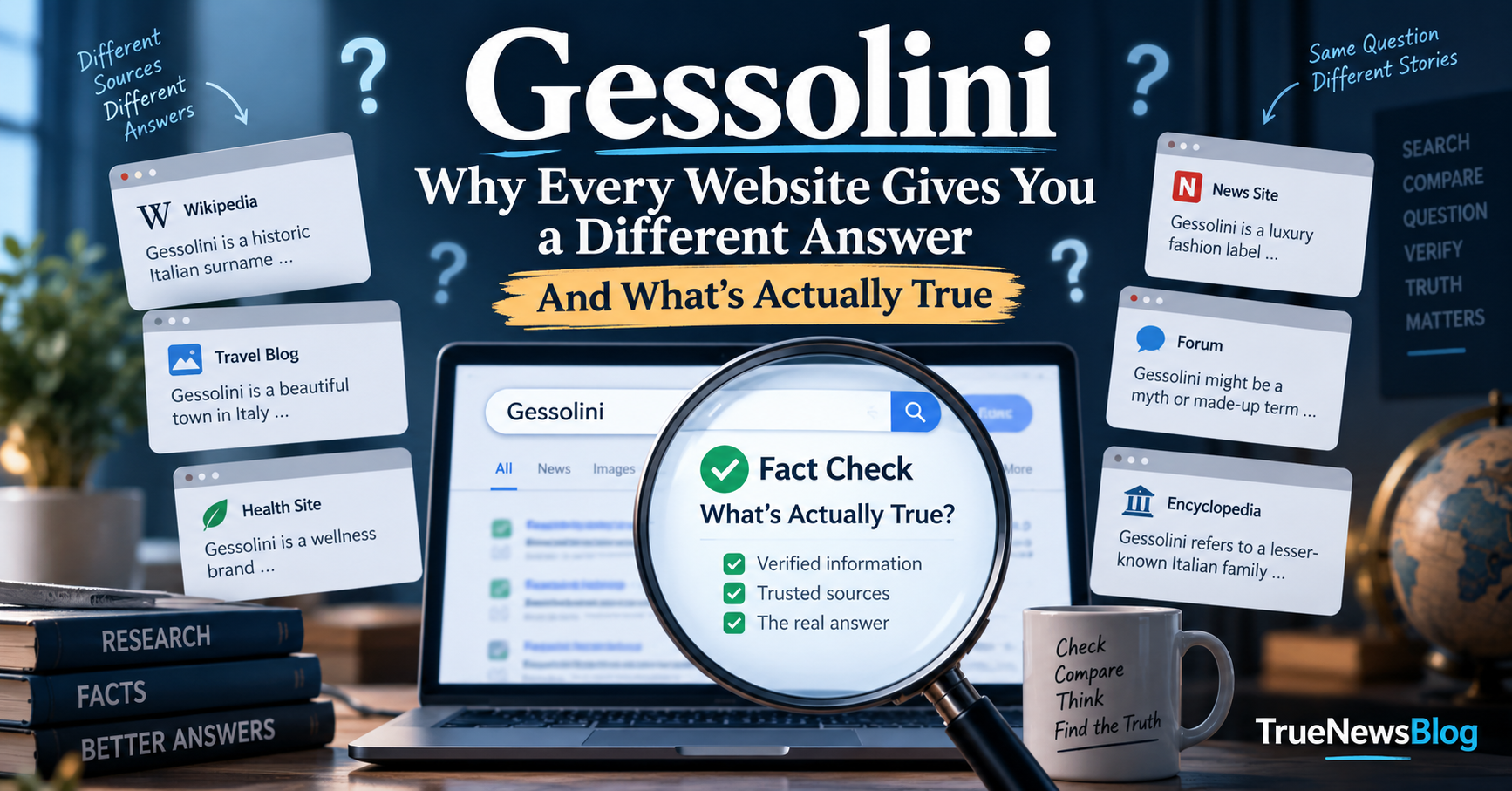
Type “Gessolini” into a search bar and something strange happens. One result calls it an Italian luxury fashion house. Another says it’s a fine art material used in restoration work. A third insists it’s a traditional artisan craft passed down through generations in rural Italy. A fourth treats it as an Italian surname. A fifth frames it as a decorative interior design finish. A sixth suggests it might just be a made-up brand name for a website.
They can’t all be right. In fact, none of them line up with each other closely enough to all be describing the same thing — and that mismatch is the actual story here.
This isn’t a case of “the internet has slightly different takes on a known word.” This is a case of a term with no fixed, verifiable meaning being defined from scratch, differently, by a wave of content published within the same rough window of time. If you’re trying to figure out what Gessolini actually means, the honest answer is more interesting than any single one of those definitions — and more useful to know.
What’s Actually Verifiable About the Word
Let’s separate fact from filler.
What’s real:
- Gesso is a genuine Italian word meaning chalk or plaster. It has centuries of documented use in fine art, where it describes a primer coating applied to canvas, wood, or walls before painting.
- Italian does use diminutive suffixes like -ino and its plural -ini to make a word feel smaller, softer, or more affectionate — the same pattern behind panino becoming panini, or bambino becoming bambini.
- Italian surnames commonly end in -ini (Bellini, Rossini, Puccini), so a word with that ending naturally sounds like a plausible Italian family name even if it isn’t one.
What isn’t backed by anything:
- There’s no dictionary entry, historical record, art-history reference, or established brand registry confirming “Gessolini” as a real word, material, craft tradition, or company name.
- The handful of Italian dictionaries and etymology resources that do cover diminutives of gesso point to actual attested forms like gessetto (a small stick of chalk) — not gessolini.
- No verifiable historical record ties the word to Renaissance workshops, regional Italian crafts, or a documented family lineage, despite several articles stating this as established fact.
So the linguistically honest read is this: “Gessolini” sounds like a real Italian word because it’s built from real Italian pieces — gesso plus a diminutive-style ending — but the specific combination isn’t an attested word with a settled meaning. It’s closer to a plausible-sounding invention than a term with a documented history.
The Competing “Definitions” Floating Around the Web
Here’s a side-by-side look at how differently this single word gets defined, depending on which page you land on:
| Claimed Meaning | Core Claim | Verifiable? |
|---|---|---|
| Luxury fashion brand | An Italian fashion house built on leatherwork and tailoring heritage | No independent brand records, press coverage, or retail presence found |
| Fine art material | Small sticks of refined plaster used in restoration and canvas prep | No art-history sources, conservator references, or supplier listings confirm this specific term |
| Traditional artisan craft | A rural Italian craft tradition tied to festivals and family heritage | No cultural, folklore, or historical documentation found |
| Italian surname | A family name derived from occupation or geography | Appears in zero surname registries or genealogy databases checked |
| Digital brand / website name | A coined, adaptable term for online identity | Plausible use case, but this describes what the word could be used for, not what it currently is |
| Interior design finish | A textured decorative plaster technique for walls and architecture | No design-industry sources, manufacturers, or trade publications use this term |
| Design “philosophy” | A mindset around slow craftsmanship and material intention | Abstract enough that it can’t be fact-checked either way |
Notice the pattern: each definition is self-contained and internally confident, but none of them reference each other, none cite a shared original source, and none point to something independently checkable outside of that one article. That’s not what you’d expect from a real, established term — even a niche one. Niche terms usually trace back to one origin that other sources then reference. This term traces back to many unconnected, contradictory origins, published in a short window of time.
You May Like: What Is Troozer com? Is It Legit, Safe, or Just Confusing? (2026)
Why a Word Like This Ends Up With So Many Fake Definitions
This is where the real information gain is, and it’s worth understanding regardless of what led you to search this specific word.
Certain uncommon-sounding terms — often invented, misspelled, or algorithmically surfaced strings — get picked up by keyword research tools because they show search volume without much competing content. That combination (people are searching it, almost nothing exists to answer it) looks like an opportunity to automated or low-effort content operations. The result is a wave of articles published around the same period, each inventing a plausible-sounding definition rather than reporting a verified one, because there’s no original source to report on in the first place.
A few signals that you’re looking at this kind of content rather than genuine reporting:
- No shared origin story. Real historical or cultural terms get referenced consistently across sources because they trace back to the same documented root. Fabricated ones don’t, because each writer is inventing independently.
- Vague sourcing. Phrases like “some sources describe it as” or “it is believed to” without naming an actual source.
- Suspiciously broad flexibility. The term gets applied to fashion, art, interior design, and branding all at once — real niche words are rarely that elastic.
- Publishing clustering. A search for the term turns up a dozen “complete guide” articles, all published within months of each other, with no coverage before that window.
None of this means someone did something illegal or dangerous. It usually just means the content was written to capture search traffic around a term that looked promising in a keyword tool, not to report on something that already existed.
If You Encountered “Gessolini” as a Brand, Product, or Website
If your search started because you saw the word used somewhere specific — a website, a product listing, a social media account — the guidance is straightforward:
- Check for independent confirmation. A real brand shows up in places it doesn’t control: press mentions, retailer listings, registered trademarks, business directories.
- Look at domain and account age. New domains or social accounts with a sudden burst of content are a signal worth noting, not a dealbreaker on their own.
- Be cautious with purchases or personal information. If “Gessolini” is being used to sell a product, verify the seller through normal e-commerce due diligence — return policy, contact information, independent reviews — before entering payment details.
- Don’t assume authority from confidence. Several of the articles describing this term are written in a highly assertive tone despite having no checkable sourcing. Confidentence in the writing isn’t evidence.
Frequently Asked Questions
What does Gessolini actually mean?
There’s no verified, established meaning. It appears to be built from the real Italian word Gessolini (chalk or plaster) combined with a diminutive-style ending, but the specific term isn’t documented in Italian dictionaries, art history sources, or surname registries.
Is Gessolini a real Italian word?
Not in any dictionary or linguistic reference that could be independently checked. Its components are real Italian language patterns, but the combined word doesn’t appear to be an attested, historically used term.
Is Gessolini a real fashion brand?
No independent evidence — press coverage, retail listings, or brand registries — supports this claim. It appears on a small number of content pages describing it as a luxury Italian fashion house, without corroboration elsewhere.
Is Gessolini used in art restoration?
There’s no art-history or conservation-industry source confirming this specific term is used by restorers or artists, despite some articles describing it as a traditional restoration material.
Why do search results about Gessolini contradict each other so much?
Because the definitions weren’t drawn from one shared, verifiable source. Each article appears to have generated its own explanation independently, which is a pattern often seen with obscure or invented search terms picked up by keyword tools rather than real cultural or historical terms.
Is it safe to assume Gessolini is just a made-up word?
Based on everything independently checkable, that’s the most accurate current explanation — a plausible-sounding, Italian-flavored coinage rather than an established word, brand, or tradition.
Read More: What Is Allysplay.com? The Real Gaming Blog Explained (2026)



One thought on “Gessolini: Why Every Website Gives You a Different Answer (And What’s Actually True)”